Career
Promotions
Leadership

Everyone tells you to find a mentor. Maybe someone’s told you to hire a coach. Your best friend is your unofficial sounding board. You’re halfway through a leadership book that’s changing how you think. You have a therapist on Tuesday afternoons.
So why does it still feel like something’s missing?
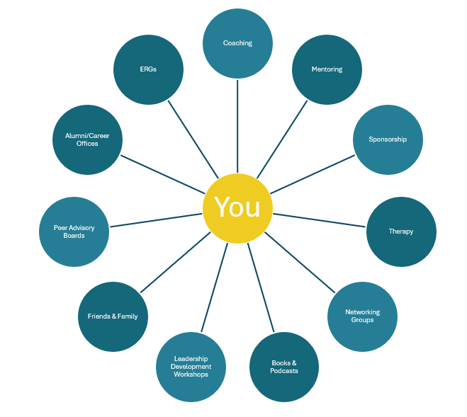
Because each of these serves a specific function — and most of us have never been handed a map. We reach for the nearest thing when we need support, whether or not it’s actually the right tool for the job. We over-rely on our friends. We expect our mentor to act like a coach — or vice versa. We consume more content and wonder why nothing changes.
Here’s the full picture: a breakdown of most types of support in your circle, what it’s actually for, and where each one falls short.
Friends & Family: Your Emotional Home Base
Your people. The ones who answer on the first ring, know your full history, and will sit with you through anything.
They are irreplaceable — and they have real limits.
Friends and family love you unconditionally, which is their superpower. But that same unconditional love can make it hard for them to challenge you when you need it. They want you to feel better. They’ll validate you when what you really need is an honest mirror. They’ll worry when you need encouragement. They’re also not living inside your career — they can offer empathy, but not expertise.
Best for: Processing emotions, gut checks, celebrating wins, unconditional support.
The risk: Over-relying on them for professional challenges they’re not equipped to solve, and burning out the relationship in the process. Your friends love you. They shouldn’t have to be your career strategists too.
Books & Podcasts: Scalable Wisdom on Demand
For the price of a paperback or a pair of earbuds, you can access decades of research, hard-won experience, and some of the sharpest thinking on leadership, career, and self-development available anywhere. Books and podcasts are extraordinary.
They’re also one-directional.
A book can give you a framework. A podcast can shift your perspective. But neither one can ask you a follow-up question. Neither one knows that you’ve been talking about having that conversation with your manager for six weeks and still haven’t done it. Neither one will check in on Thursday.
Best for: Building mental models, learning from others’ experience, finding language for things you already sense but haven’t named, exploring ideas before you take action.
The risk: Mistaking consumption for development. There’s a meaningful difference between knowing something and doing something. Books and podcasts are rich input — but without accountability and application, they stay in your head.
Therapist: Your Past and Your Patterns
A therapist works backward. Their job is to help you understand the underlying beliefs, experiences, and behavioral patterns that are driving how you show up — often in ways you can’t fully see from the inside.
This work is critical. And it’s distinct from everything else on this list.
Therapy addresses root causes. It’s the right tool when what’s holding you back has origins deeper than strategy or skill — when you keep repeating the same patterns in different workplaces, when your inner critic is drowning out everything else, when you need to heal before you can grow.
Best for: Healing, root-cause work, mental health, breaking cycles, processing major life events.
The risk: Expecting therapy to do the work of career strategy — or expecting a career coach to do the work of a therapist. These are different disciplines. A good coach knows where the boundary is.
Coach: Your Forward Motion
Coaching operates on a different premise than most people expect. A coach doesn’t tell you what to do. They don’t share their own career path as a model for yours. They don’t have a roadmap you’re supposed to follow.
A coach works from the belief that you are naturally creative, resourceful, and whole — that you already have the answers, and that their job is to help you access them. They mirror, challenge, hold space, and help you see where you might be getting in your own way.
This is distinctly forward-facing work. Where a therapist helps you understand your past, a coach helps you move toward your future.
Best for: Getting unstuck, navigating transitions, building self-awareness, making decisions with more clarity, closing the gap between where you are and where you want to be.
The risk: Expecting a coach to be a mentor (give you the roadmap) or a sponsor (open doors for you). A coach’s own career trajectory is largely beside the point. Their job isn’t to tell you what they did — it’s to help you figure out what you’re going to do.
Mentor: Someone Who’s Been There
A mentor is typically one or two steps ahead of you — someone who has held your role or a similar one and is willing to share how they navigated it. Mentorship is experience-sharing. It’s specific, contextual wisdom from someone who has already walked the road you’re on.
But here’s something most people get wrong: the mentee has to drive the relationship. A good mentor has finite time. They’re not going to show up with a plan for your career. That’s your job. Come with specific goals. Make it easy for them to say yes. Know what you’re asking for.
And here’s something the research has made clear: one mentor is no longer enough. MIT Sloan researchers (Shen, Cotton & Kram, 2015) found that in today’s complex professional environment, the idea that a single mentor can meet all of your developmental needs is increasingly outdated. What actually works is an array of advisors, peers, and role models who can provide the right support at the right moment.
Best for: Role-specific wisdom, navigating organizational politics, career mapping, learning from someone’s real experience in a role you’re moving toward.
The risk: Expecting one mentor to cover everything — or approaching the relationship without clear asks and letting it fizzle.
Sponsor: Your Advocate in the Room
A sponsor is not a mentor. This distinction matters enormously, and confusing the two is one of the most common mistakes early and mid-career women make.
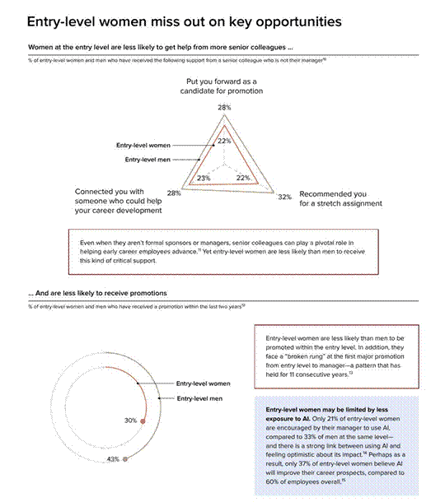
Source: McKinsey & LeanIn.Org, Women in the Workplace 2025
A sponsor is a senior leader who champions you when opportunities arise — in conversations and rooms you’re not in. They put their reputation behind your name. That’s a significant ask, which means this relationship requires you to actively feed it: share your wins, signal your ambitions, make it easy for your sponsor to advocate for you with specifics.
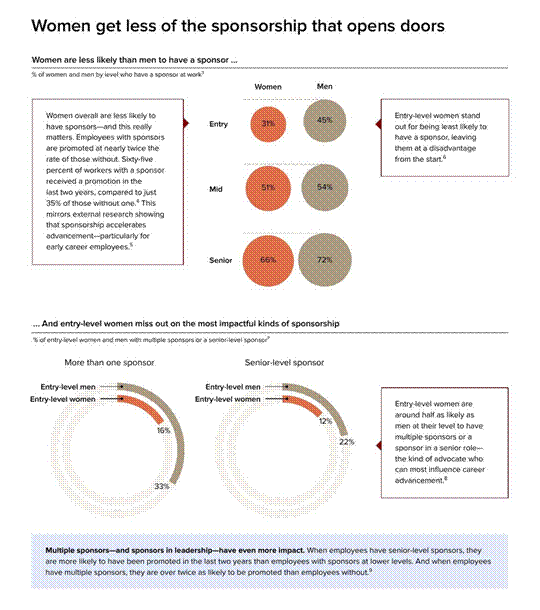
Source: McKinsey & LeanIn.Org, Women in the Workplace 2025
Women often have people willing to advise them, but far fewer who will actively put their name behind an opportunity on their behalf.
Best for: Promotions, high-visibility assignments, access to opportunities and rooms you’re not yet in.
The risk: Confusing mentorship with sponsorship and not taking responsibility for nurturing the relationship. A mentor advises you. A sponsor advocates for you. Both matter. They’re not the same thing. A sponsor is staking their reputation on you. Make it impossible for them to look bad.
Your Network: Wide but Shallow
Networking gets a lot of attention, and for good reason — your network shapes your opportunities in ways that are hard to overstate. But a broad network and a strong support system are not the same thing.
Harvard Business Review’s research on this is clear: a smaller, curated group of people you can go deep with consistently outperforms a large, surface-level network. Near-peers — people at your exact career stage, navigating what you’re navigating — are the most willing to offer real, tactical support.
Best for: Exposure, opportunity, serendipity, expanding your professional world.
The risk: Mistaking a large network for real support. A thousand LinkedIn connections won’t hold you accountable, challenge your thinking, or sit with you when you’re genuinely stuck.
Employee Resource Groups (ERGs)
ERGs are internal groups within a company, organized around shared identities, backgrounds, or interests — women’s networks, BIPOC communities, LGBTQ+ alliances, and similar. They exist to create community, connect colleagues who share an experience, and sometimes to influence company culture and policy from the inside.
The community they offer is real. So are their limits.
ERGs operate within your organization, which means the candor has a ceiling. You’re still colleagues. You may be competing for the same roles. The things you can say in a room full of co-workers — even a comfortable one — are different from what you can say somewhere outside your company’s walls. And the quality of ERG programming varies widely depending on how much the company actually invests in it.
Best for: Community within your organization, connecting with colleagues who share your experience, internal visibility, and access to company-sponsored programming and leadership.
The risk: Mistaking internal community for the kind of candid, high-trust peer support that comes from outside your organization. ERGs offer belonging. They’re not built for the professionally focused, honest conversations that a peer advisory board can hold.
Leadership Development Workshops
A workshop gives you a room, a facilitator, and a few focused hours or days. At their best, they’re energizing — new frameworks, new language, a room full of people working through similar challenges.
They’re also time-stamped.
The learning happens in the session. What you do with it afterward is entirely up to you. There’s no follow-up structure, no one asking three weeks later whether you actually tried that new approach with your team. And the connections you make tend to stay in the room. When you get back to your desk, you’re faced with the reality that your team did not attend the same training so hasn’t been enlightened. And, your work has piled up so you get back in your lane and keep going.
Best for: Targeted skill development, exposure to new frameworks, meeting people working through the same problems you are. Companies are most likely to pay for this kind of professional development.
The risk: Treating attendance as development. A workshop is a starting point, not a support system. Without something to activate the learning afterward — a peer group, a coach, a practice partner — most of it stays in your notes.
Alumni Networks & Career Offices
Both exist to support your career. Alumni networks connect you to people who share your educational background — a warm introduction waiting to happen. Career offices offer institutional resources: job boards, employer relationships, resume reviews.
Both also have real limits once you’re a few years in.
Alumni connections are still networks — warm and familiar, but wide and shallow. Shared history doesn’t automatically translate to real support. And career offices are built for placement, not for navigating a leadership transition. They know what to do with you when you’re looking for your first job. They’re less equipped for the messy middle.
Best for: Warm introductions, growing your network, industry access, job searching, reconnecting with people who share your educational path.
The risk: Expecting institutional resources to meet developmental needs they weren’t built for. The connection is real; the depth, usually, isn’t.
Peer Advisory Board: The Glue That Holds the Circle Together
This is the one most early and mid-career women are missing — and the one they most consistently say they can’t find.
A peer advisory board is a small, structured group of peers at a similar career stage who meet regularly to advise each other on real professional challenges. It’s confidential. It’s facilitated. And it’s built for the long term.
It is not a networking event. It’s not a workshop. It’s not a mentoring relationship. It’s something different from all of the above — and it fills a gap that none of them can.
Here’s what makes it distinct:
- Unlike your friends: structured, professionally focused, and offers challenge alongside support
- Unlike your mentor: peer-level and reciprocal — everyone brings something, everyone gets something
- Unlike your network: small, deep, and consistent — the same people, month after month, building real trust
- Unlike a book or podcast: it asks you follow-up questions. Next month, someone is going to ask what happened.
- Unlike group coaching: no set curriculum — the agenda flexes around what members actually need
What peer advisory boards consistently produce — and the research backs this up — is career progression, higher job satisfaction, and better psychological well-being. The mechanism is three things working together: shared experience, structured accountability, and a relational environment where people feel safe enough to bring their real challenges.
Best for: The gap everything else leaves. The accountability, consistency, and peer perspective that early and mid-career women say they can’t find anywhere else.
The risk: Not all peer advisory boards are created equal. A group that’s poorly vetted — where members don’t show up consistently or treat it as a one-way street — won’t deliver. The structure, the curation, and the facilitation matter enormously. A well-run board is transformative. A loosely organized one is just another thing on your calendar.
The Full Picture
No single one of these is enough on its own. The most supported, most effective women don’t have just a mentor or just a coach — they have a layered system. Each role plays a part. Each fills a different gap.
The question isn’t which one to choose. It’s: which ones do you have? Which ones do you need and when? And which ones are missing?
The next post makes the case for why peer advisory boards — specifically — are the piece that most early and mid-career women are missing, and what the research says about why they work.